A debounce refers to the glitches present in a physical circuit when a button or switch is triggered.
When pressed, the signal oscillates for a short time before stabilizing.
A debounce circuit is designed to:
- Filter out glitches
- Produce a clean square wave output
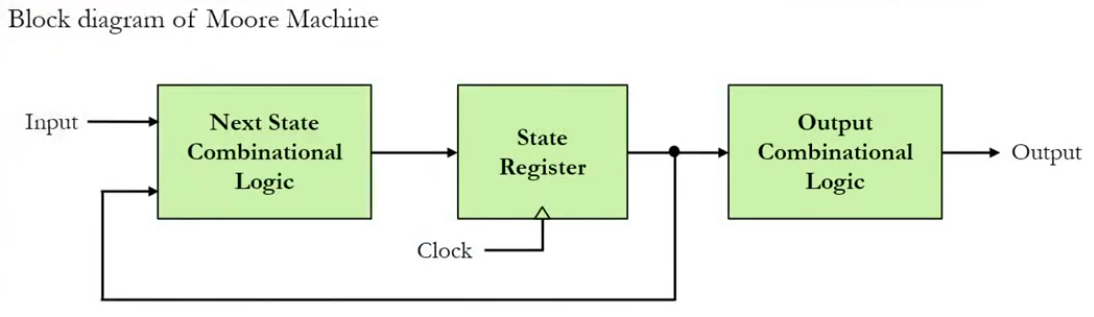
This circuit can be implemented as a Moore Machine.
Concept

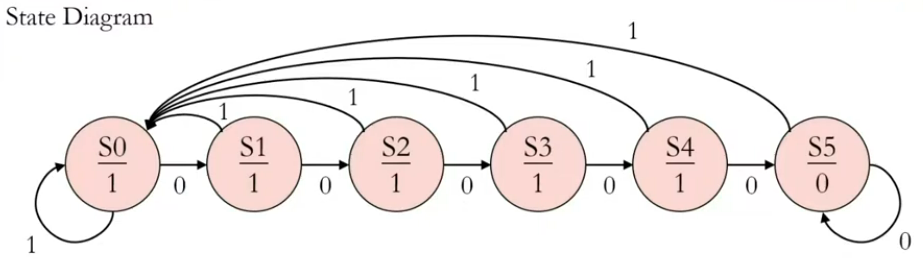
- The idle state (before button is pressed) is S0.
- The following states (S1 → Sn) act as a stabilizing filter.
- More states = better debounce effect but also more delay.
State Diagram
Block Diagram
Verilog Implementation
module Debounce_Circuit(
    input Din, clk, reset,
    output reg Dout
);

    reg [2:0] cs, ns;

    // Next State Combinational Logic
    always @(*) begin
        case(cs)
            3'd0: ns = (Din) ? 3'd0 : 3'd1;
            3'd1: ns = (Din) ? 3'd0 : 3'd2;
            3'd2: ns = (Din) ? 3'd0 : 3'd3;
            3'd3: ns = (Din) ? 3'd0 : 3'd4;
            3'd4: ns = (Din) ? 3'd0 : 3'd5;
            3'd5: ns = (Din) ? 3'd0 : 3'd5;
            default: ns = 3'd0;
        endcase
    end

    // State Register
    always @(posedge clk or negedge reset) begin
        if (!reset)
            cs <= 3'd0;
        else
            cs <= ns;
    end

    // Output Combinational Logic
    always @(*) begin
        case(cs)
            3'd0,
            3'd1,
            3'd2,
            3'd3,
            3'd4: Dout = 1'b1;  // Stable high before pressed
            3'd5: Dout = 1'b0;  // Button stable pressed
            default: Dout = 1'b1;
        endcase
    end
endmodule