The Ping Protocol was introduced in USB 2.0 for high-speed OUT transactions to reduce wasted bandwidth. It is only defined for high-speed devices.
Applies to:
- Bulk OUT endpoints
- Control OUT data stage transactions
Problem: Wasted Bandwidth
During an OUT transaction, the host sends an OUT token packet followed by the data packet. If the target endpoint buffer cannot accept the data, the data must be discarded and the transaction must be retried.
Low- and full-speed USB Bulk and Control OUT transactions suffer a bandwidth penalty when a NAK handshake is returned, because the data sent from the host must be discarded by an endpoint if it cannot accept the data. This penalty is even more severe for high-speed devices due to the larger data payload size.
Example: OUT Data NAK
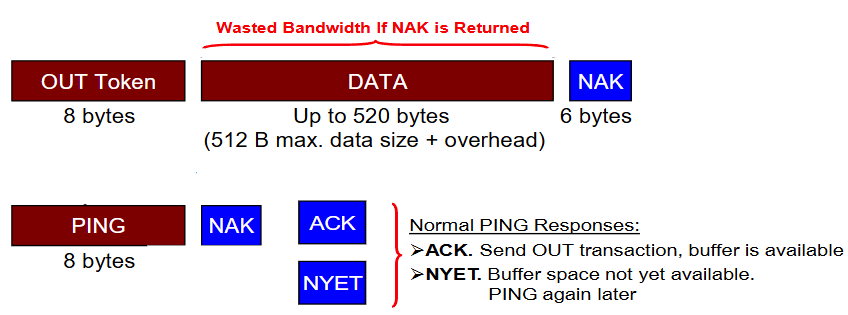
In this example, an OUT transaction with a 512-byte payload is delivered to an endpoint that cannot accept the data. The endpoint has a full buffer and cannot store the data, so:
- The data is simply dropped
- A NAK is returned
- ~520 bytes of bandwidth is wasted (512B data + overhead)
This type of behavior is not uncommon and results in large amounts of bandwidth being wasted.
Solution: Ping Protocol
Rather than sending large data payloads that are rejected time after time, the Ping protocol requires first checking whether a device is ready to accept the data before sending it.
Ping Responses
There are two typical responses to a PING packet:
| Response | Meaning |
|---|---|
| NYET (Not Yet) | Target endpoint is not ready to receive data |
| ACK (Acknowledge) | Endpoint is ready to receive the OUT transaction |
The Ping protocol also defines how often a ping packet should be sent so that bandwidth is not wasted by sending back-to-back-to-back ping packets.
Ping Protocol Sequence Example

1. Host ──── PING ──────────► Device
   Host ◄─── NYET ──────────── Device    (not ready — buffer full)

2. Host ──── PING ──────────► Device
   Host ◄─── ACK ───────────── Device    (ready — buffer available)

3. Host ──── OUT Token ──────► Device
   Host ──── DATA (512B) ────► Device
   Host ◄─── ACK ───────────── Device    (data accepted)
In this example:
- The first ping response is NYET, indicating the device is not ready to accept data
- The second ping results in ACK, indicating the device is ready
- The host then performs the OUT transaction with the 512-byte data payload
Bandwidth Comparison
| Method | Bytes on the wire | Result |
|---|---|---|
| OUT + NAK (failed) | ~520 bytes | Data discarded — wasted |
| PING + NYET | ~8 bytes | No data sent — minimal overhead |
| PING + ACK + OUT | ~8 + ~520 bytes | Data delivered successfully |
The PING token is only a few bytes, compared to 512+ bytes for a wasted data packet.
NYET vs. NAK Response
| Response | Sent in Response to | Meaning |
|---|---|---|
| NYET (Not Yet) | PING token | Endpoint buffer is not available — retry PING later |
| ACK (Acknowledge) | PING token | Endpoint buffer is available — proceed with OUT transaction |
| NAK (Not Acknowledge) | OUT data packet | Endpoint could not accept the data — data discarded |
When a device responds with ACK to a PING, the host can immediately send the OUT transaction with confidence that the data will be accepted.
Applicability
| Transfer Type | Ping Protocol Used? |
|---|---|
| High-speed Bulk OUT | Yes |
| High-speed Control OUT (data stage) | Yes |
| Full-speed or low-speed OUT | No — Ping is HS-only |
| High-speed IN transactions | No — device only sends when data is available |
| Isochronous OUT | No — no handshake mechanism |
| High-speed Interrupt OUT | No — guaranteed bandwidth allocation |
Benefits
- Reduced bandwidth waste — Only 8 bytes for PING+NYET vs. 520 bytes for OUT+NAK
- Improved bus efficiency — Especially important when devices are frequently busy
- Better for high-speed — The larger the payload (up to 512B), the greater the savings
Relationship to SuperSpeed
In USB 3.0 SuperSpeed, the Ping protocol is not needed. SuperSpeed replaces it with an asynchronous flow control mechanism:
- Device sends NRDY (Not Ready) when it cannot accept data
- Device sends ERDY (Endpoint Ready) when it becomes ready — device-initiated notification
See End-to-End Protocols (USB SuperSpeed)#3. Polled Flow Control for details.