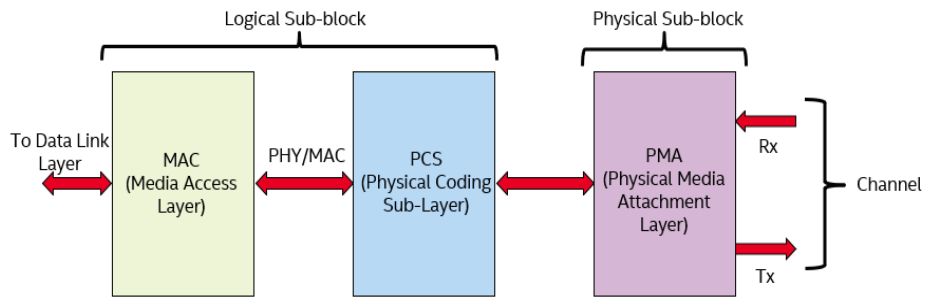
In conventional PCI Express (PCIe), the Physical Layer (PHY) is composed of three sublayers:
- Media Access Control (MAC)
- Physical Coding Sublayer (PCS)
- Physical Media Attachment (PMA)
Media Access Control (MAC)
The MAC sublayer includes the following functions:
- Link Training and Status State Machine (LTSSM)
- Lane-to-lane deskew
- Encoding and decoding:
- 8b/10b (earlier PCIe generations)
- 128b/130b (newer PCIe generations)
- Elastic buffer (in SerDes-based architectures)
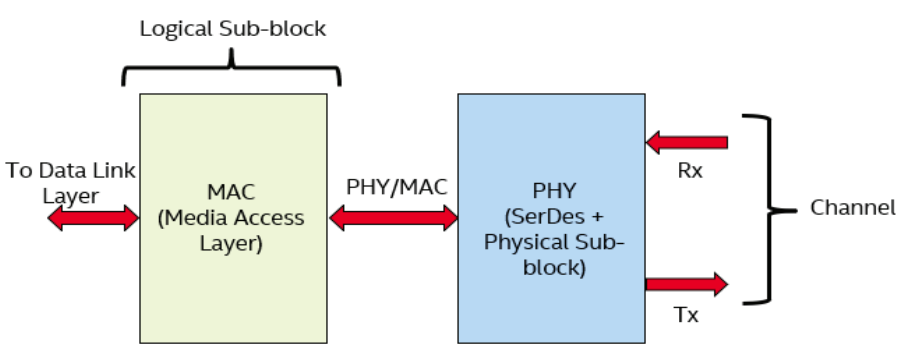
In a SerDes architecture, many PCS functions are migrated from the PHY Functional Blocks into the controller, effectively becoming part of the MAC sublayer.
Physical Coding Sublayer (PCS)
The PCS is responsible for:
- Receiver detection (Rx detect)
- Power sequencing
Physical Media Attachment (PMA)
The PMA, also referred to as the Physical sub-block, contains:
- High-speed analog and digital circuits
- Differential transmitters and receivers
- Analog buffers
- SerDes
- A 10-bit interface
This layer directly interfaces with the PCIe link.