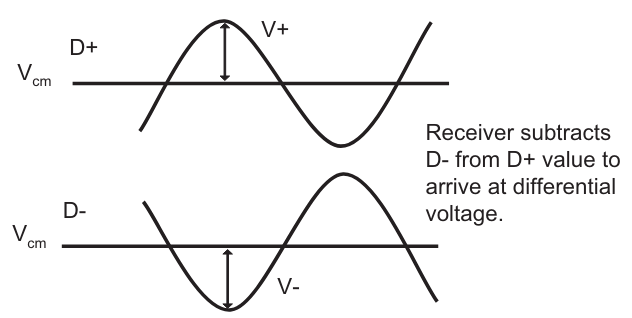
- Each lane uses two wires instead of one — carrying:
- D+ = positive version of the signal
- D− = negative (inverted) version of the same signal
- The receiver subtracts D− from D+ to reconstruct the signal.
This effectively doubles the number of pins (two pins per signal), but it’s worth it
Advantages of Differential Signaling
| Advantage | Explanation |
|---|---|
| Noise Immunity | Both wires are routed very close together, so any noise (like EMI, crosstalk, ground bounce) affects them equally. When the receiver subtracts D− from D+, the noise cancels out, leaving a clean signal. |
| Lower Voltage Swing | Because noise immunity is improved, PCIe can use a much smaller voltage swing (e.g., 0.8 V or less) compared to PCI (5 V/3.3 V). Smaller swing = faster transitions = higher frequency operation. |
| Better Signal Integrity | Differential pairs are tightly controlled for impedance, reducing reflections and improving high-speed transmission reliability. |
| Less EMI Radiation | The equal and opposite signals create electromagnetic fields that cancel each other, reducing interference to nearby circuits. |
Why It Matters for PCIe
At multi-gigabit speeds (2.5 GT/s, 5 GT/s, 8 GT/s+):
- Single-ended signals would be very noisy, require large voltage swings, and be prone to jitter.
- Differential pairs allow clean, fast transitions with very small swings, which makes it possible to scale PCIe to higher generations (Gen4 16 GT/s, Gen5 32 GT/s, etc.).