An open-loop solution is one method for transferring signals across Clock Domain Crossing (CDC) boundaries using synchronizers.
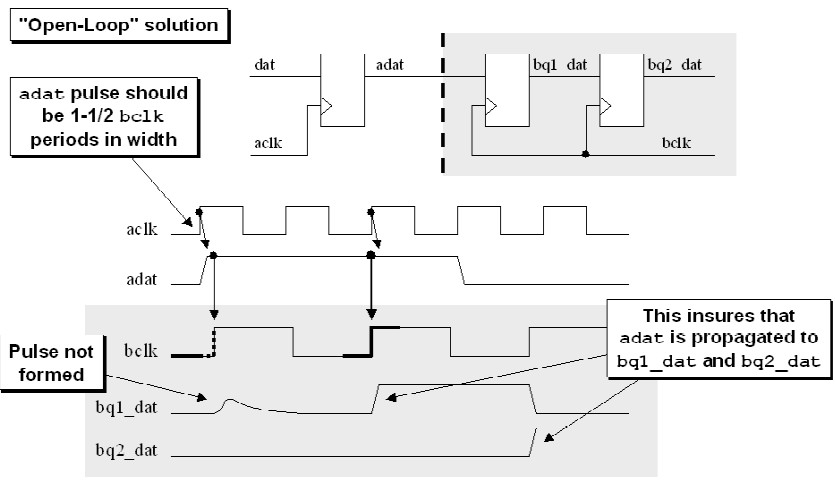
In this approach, the CDC signal is asserted (held high) for a duration longer than one full cycle of the receiving clock.
This ensures that the receiving clock will sample the signal at least once — and often twice — during its active period.
🧮 Timing Requirement
The minimum pulse width for a CDC signal should be:
≥ 1.5 × the period of the receiving clock frequency
This is equivalent to ensuring that the signal remains stable for three destination clock edges (the “three-edge” requirement).
When this condition is met, the signal will reliably be captured by the receiving clock domain without the need for feedback or acknowledgment.
⚙️ When to Use Open-Loop Sampling
Open-loop synchronization can be safely used only when:
-
The relative clock frequencies between the source and destination domains are fixed and well understood, and
-
The timing relationship has been thoroughly analyzed to ensure compliance with the “three-edge” requirement.
✅ Advantages
-
High speed:
The open-loop solution is the fastest way to transfer signals across CDC boundaries. -
No acknowledgment required:
The sender does not need to wait for confirmation from the receiving domain.
⚠️ Disadvantages
-
Risk of misuse:
Another engineer might mistake the design for a general-purpose CDC solution, leading to potential reliability issues in future revisions. -
Design changes:
If clock frequencies or timing relationships change later, the original analysis may become invalid, causing synchronization failures.
To mitigate these risks, it’s good practice to add a SystemVerilog Assertion (SVA) that monitors the input pulse width and ensures it always satisfies the “three-edge” rule.
🧩 Summary
| Aspect | Open-Loop Solution |
|---|---|
| Speed | Very fast (no acknowledgment) |
| Complexity | Low |
| Reliability | Dependent on fixed timing analysis |
| Risk | Failure if design parameters change |
| Best Practice | Verify using SystemVerilog assertions for pulse width ≥ 1.5× receiving clock period |